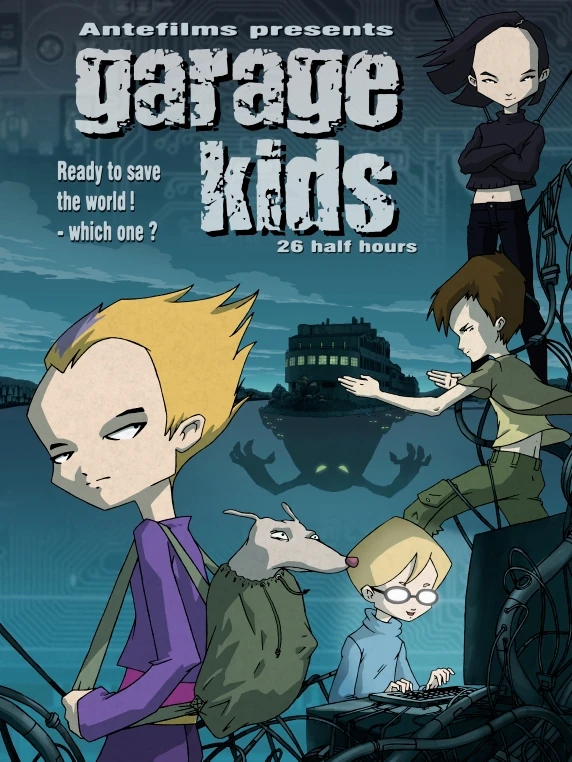
Original Promotional Poster
The Garage Kids Logo
Garage Kids is a short pilot episode made in 2001 that was the original concept of Code Lyoko, which entered production in 2003.
Plot
- From the Garage Kids Promotional Documents:[1]
"A group of kids whose adventures take place in the real world but also in a parallel and virtual world, Xanadu. The story? A boy of about twelve, Odd, arrives one day in his new neighborhood and quickly understands at school that certain friends of his are gifted with extraordinary powers. Yumi, for example, is telepathic, while Ulrick has the gift of displacing himself at the speed of light.
These kids have in fact penetrated the secret of Xanadu, the fruit of the labors of a research group whose laboratory, set in an environment inspired by the old Renault automobile factory on the Île Seguin at Boulogne-Billancourt, is now abandoned. Created by the Professor, a learned eccentric who gradually sunk into madness, the virtual world of Xanadu and its multiple disturbances threaten to destroy the real world.
Built on the model of a soap opera which unfolds through the series, Garage Kids offers in each of its 26 episodes of 26 minutes a complete story in which Odd and his friends – Yumi, Ulrick and also Jeremie, a computer wizard – try to end one of the disturbances in the computer network caused by Xanadu's exuberance. While the idea of clandestine natures and hidden identities should seduce the children while feeding their imaginations, Garage Kids rests on the fascination that video games hold for kids today. A confrontation between the real world and Xanadu fully vindicates that of 2D and of 3D. Influenced by the poetry and the visual impact of Japanese animation, the series proposes a graphic universe that's particularly original and strong."
Production
Thomas Romain and Tania Palumbo originally made the short film Les enfants while they were attending the Parisian animation school Gobelins.[2] It was produced as the introduction short for the 2000 Annecy International Animated Film Festival.[3][4] Interested by its atmosphere, they were hired by Christophe Di Sabatino and Benoît Di Sabatino from the animation studio Antefilms to develop it into a series, with Carlo de Boutiny being brought on to help them write the literary bible.[5][6][7]
Four children were selected from Les enfants to serve as main characters. Their personalities were inspired by people the creators knew in real life, with Yumi being primarily based on Palumbo herself.[8] She chose the first names for the characters. Jeremie was named after their former classmate Jérémie Périn, while Odd's came from the English word's meaning of "strange" to highlight his "extraordinary" side.[5]
The Matrix had "enormous influence" in the early planning stages according to Romain, citing the concept of a machine allowing the characters to dive in a virtual world, an operator who supervises the trip and the correlation between the action in the real world and the virtual world.[5] Anime also served as inspiration, with reference series including Serial Experiments Lain for its "worrying digital dimension" and Neon Genesis Evangelion for its dangerous entities to fight among others. Although some have noted similarities to Tron, including Codelyoko.fr, Romain later admitted he hadn't seen the film yet when they were developing the series.[9][5] Initially plans were to have the show be entirely made with traditional animation. Antefilms however suggested using computer animation for the virtual world for a combination of reasons; including to make the series unique, make the separation between each world clearer, to promote a video game theme and the studio needing work for their 3D department. From there, the trio produced Garage Kids as a prototype.
Romain and Palumbo wanted the series to represent "the France we knew, especially the outskirts of Paris", as they disliked what they perceived as "fantastic or Americanized" settings other French cartoons used at the time, which Romain attributed to the producers "thinking that their cartoons would be exported better that way".[5] They modelled the factory on the Renault production plant on Île Seguin in Boulogne-Billancourt, which has since been demolished.
Originally Garage Kids was envisioned as a 26-episode series with a continuous storyline, which Romain described as: "[...] we would have discovered the virtual world and its dangers at the same time as the heroes, seen them discover new powers, go on adventures and protect reality from a computer virus".[10] The series had fairly dark themes in mind, with Romain saying they wanted to avoid making the series "too playful and artificial" and "get around the censoring done by TV channels that tend to soften youth programs" by "writing episodes with tension, suspense, even tragic scenes. Things that are hard to imagine seeing in a cartoon series for kids".[5]
However, television networks were hesitant to produce the series, worrying its serial story would put-off viewers who missed the first few episodes and they wanted to rerun the series without worrying about episode order. As a result, the writing team ultimately decided to switch to an episodic format.
The project eventually evolved into Code Lyoko's Season 1 graphic bible over 2002. The series was renamed to Code Lyoko by Palumbo and Anne de Galard after it was greenlit by France 3 and Canal J at the request of producers, who found "Garage Kids" too unclear of a title.[11]
Thomas Romain, unhappy at the loss of the serial element, left Code Lyoko in early 2003 to move to Japan and work on Ōban Star-Racers.[5]
Trivia
- Here, Ulrich's name is spelled differently: as "Ulrick."
- Here, Ulrich's katana blade is made of binary code.
- The school is unnamed and more resembles a Japanese high school.
- Superpowers, such as Yumi's telekinesis and Ulrich's Super Sprint, are capable of being used in the real world as well as the virtual world of Xanadu. This was ultimately dropped in Code Lyoko by series director Jérôme Mouscadet, who wanted the line between the real world and the virtual world to be as clear as possible for younger viewers.[12]
- Odd seemingly intended not to go to Xanadu; afraid of being virtualized.
- Neither Aelita nor X.A.N.A. are present in this version; Xanadu is instead haunted by monsters who activate towers and are not controlled by some higher power. And seemingly to deactivate a tower, one must kill the monsters haunting the tower.
- Sophie Decroisette later revealed that, aside from the promotional documents, Garage Kids' plot was still largely unwritten when it was produced, saying: "[...] I really just saw a teaser that was focusing on images, there were great ideas in the images, notably the transition from one universe to the other, but plot-wise, it was just "they travel from one universe to the other", with no explanation on "how" and "why". They had no real motivation, they were fighting [Xanadu], which was represented as black spheres, something like this, but none of this was clearly defined."[13]
- The Return to the Past function was not yet created in this version. It was ultimately added to Code Lyoko by writer Frédéric Lenoir sometime before Decroisette joined the series in September 2002, who was looking for an explanation on how X.A.N.A. could cause destruction to the real world, have other people witness it, and have the heroes be able to fix it without arising suspicion.[6][14]
- Ulrich's pants are much poofier, unlike in Code Lyoko. This is due to them being modeled after real-life hakama.
- The virtual world's name, Xanadu, comes from the 1941 film Citizen Kane.[15] It also helped inspire the name of Code Lyoko's villian X.A.N.A..[16]
- The 2D animation in Garage Kids and Les enfants is much more fluid than the animation in Code Lyoko, likely the result of both being done in-house in France, whereas Code Lyoko's was outsourced to Hong Kong.
- The character art that appears during the credits were reused in the credits sequence for the first season of Code Lyoko. In addition, the scenes where the characters are virtualized were recycled throughout the first three seasons, as well as episodes of Season 4 that used the old style of clothing.
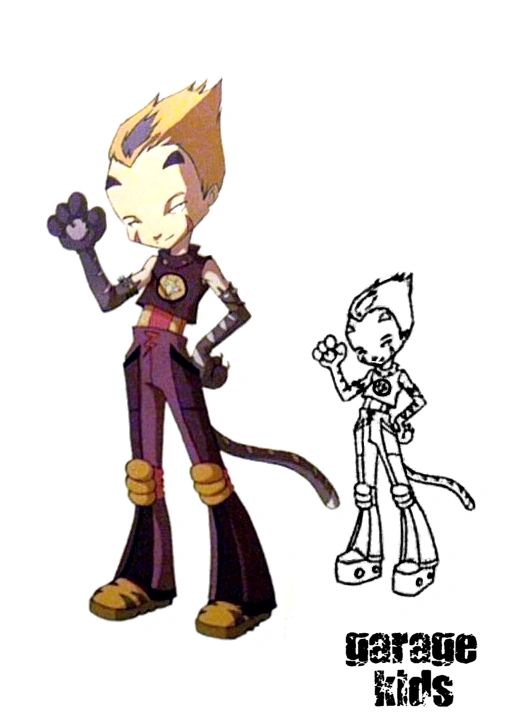
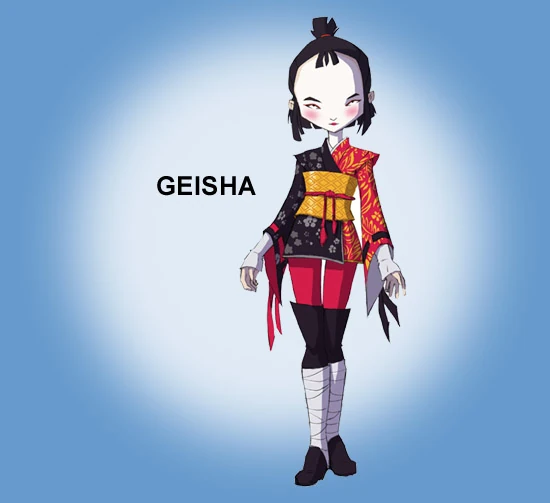
- While not seen in 3D, Odd and Yumi's virtual designs have been seen in concept art, Odd's design is virtually unchanged in Garage Kids, aside from a more disco-esque design of his shoes, and Yumi had longer sleeves.
- There are two pieces of music that play in this short.
- The first one is "Pirates" from the soundtrack of the 1998 movie, Six Days Seven Nights.
- The second one during the credits is "Love Foolosophy" by Jamiroquai.
- Promotional artwork from Les enfants was used during initial promotion of Garage Kids as a series, perhaps hinting that the characters featured in the short were all planned to have some sort of role in the series at that point. Aside from the characters that would form the basis of the Lyoko Warriors, as well as Milly and Tamiya, these remaining characters were removed by the time the concept evolved into Code Lyoko proper.
- The unnamed "Professor" character served as a prototype for Waldo Schaeffer, who was officially named Franz Hopper in the Season 1 bible, albeit with an altered backstory (his proposed madness and building the supercomputer was changed to him simply disappearing while researching a supercomputer he had found).[7] Interestingly, the Season 2 graphic bible revisions would bring Franz's backstory in Code Lyoko proper closer to his original prototype's background in spirit, wherein he did build the supercomputer, and went insane from overusing the Return to the Past function.
Gallery


Other


Video
References
- ↑ "Antefilms presents Garage Kids". CodeLyoko.net. November 14, 2001.
- ↑ "Aujourd’hui ce projet porte le nom de Garage Kid". AnimeLand.com. June 1, 2002.
- ↑ "Thomas Romain (2013)". manganimation.net. June 3, 2013.
- ↑ "Gobelins - Films d'Annecy 1999/2000/2001 (relativement inédits)". Catsuka. April 2, 2011.
- ↑ 5.0 5.1 5.2 5.3 5.4 5.5 5.6 ""Code Lyoko" arrive sur Netflix: l'histoire secrète de la série culte". BFMTV. January 10, 2020.
- ↑ 6.0 6.1 "Interview - Sophie Decroisette, partie 1". Ces Dessins Animés-Là qui méritent qu'on s'en souvienne. March 4, 2014.
- ↑ 7.0 7.1 "The Graphic Bible of Code Lyoko" - CodeLyoko.fr
- ↑ "Exposition organisée au sein de l’école des Gobelins…". Codelyoko.net. October 18, 2006.
- ↑ "Sources of inspiration > Tron Legacy" - CodeLyoko.fr
- ↑ Reply from Thomas Romain to "[animation] Code Lyoko (up p41 expo aux gobelins)". Catsuka. September 5, 2003.
- ↑ "Interview with Sophie Decroisette" - CodeLyoko.fr (2007)
- ↑ "Avant première Code Lyoko saison 4". CodeLyoko.fr. July 5, 2007.
- ↑ "Interview - Sophie Decroisette, partie 2". Ces Dessins Animés-Là qui méritent qu'on s'en souvienne. March 11, 2014.
- ↑ "Les secrets de Code Lyoko racontés par ses créateurs (et on sait pourquoi ils ont des grands fronts)" (3:26) - YouTube
- ↑ "Les secrets de Code Lyoko racontés par ses créateurs (et on sait pourquoi ils ont des grands fronts)" (6:15) - YouTube
- ↑ Reply from Sophie Decroisette to "[animation] Code Lyoko (up p41 expo aux gobelins)": "[...] it's a name that emanates from Xanadu, the old name of Lyoko. So it's not an acronym...". CATSUKA. April 1, 2004.
| This article uses material from the Wikipedia article Code Lyoko, which is licensed under CC-BY-SA (view authors). |